← All our book clubs

Video Summaries

A short video recap of each week of The Heart of the Buddha's Teaching. Missed a Sunday? Start here.

Before We Began

Announcements from the Christians Anonymous newsletter

From the Christians Anonymous newsletter

Interested in a Fall Book Club? · September 17, 2026

Friends,

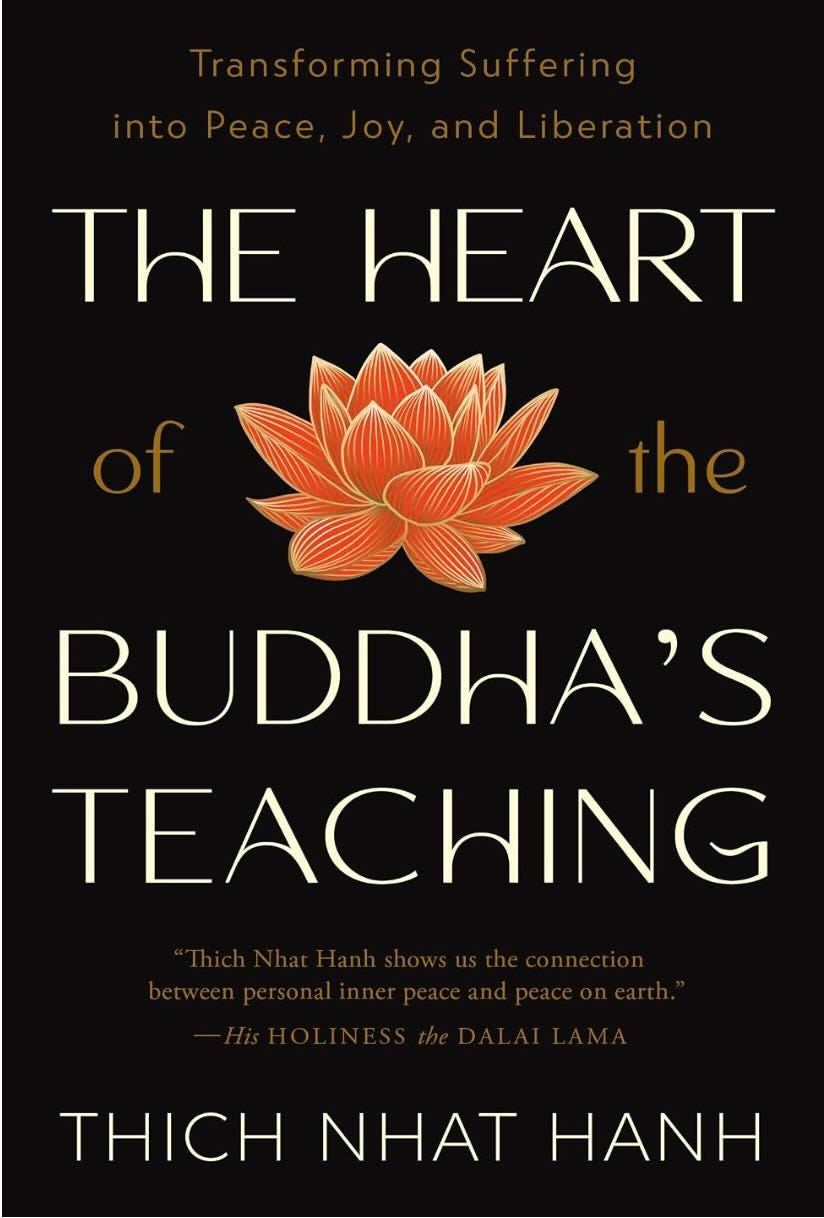
I’ve had several ideas for a fall book club. This is the one worth doing. “The Heart of the Buddha’s Teaching” is a classic text by Thich Nhat Hanh, Vietnamese Zen monk and peace activist whom Rev. Martin Luther King Jr nominated for the Nobel Peace Prize. He founded a school of thought called “Engaged Buddhism.” It combines ancient Buddhist texts with Western psychology. He promotes the individual’s active role in creating change. Sounds great. And it encroaches on a common understanding of the Holy Spirit.

Here are three examples of intersections of the Christian and Buddhist traditions.

  • Stopping, resting, calming as strategies to combat suffering vs Jesus urging prayer and Paul writing that we are “sorrowful, yet always rejoicing,” (2 Corinthians 6:10).

  • Uncovering our cognitive distortions vs “Do not be conformed to this world, but be transformed by the renewing of your minds,” (Romans 12:2).

  • Mindfulness in peaceful communication vs “With the tongue we curse those who are made in the likeness of God,” (James 3:9–10).

We won’t try to blend or debate the two distinct traditions. Our purpose is to learn from another tradition in a way that enriches our Christian faith.

What do you think? Let me know.”

Peace and Love,

Ellis

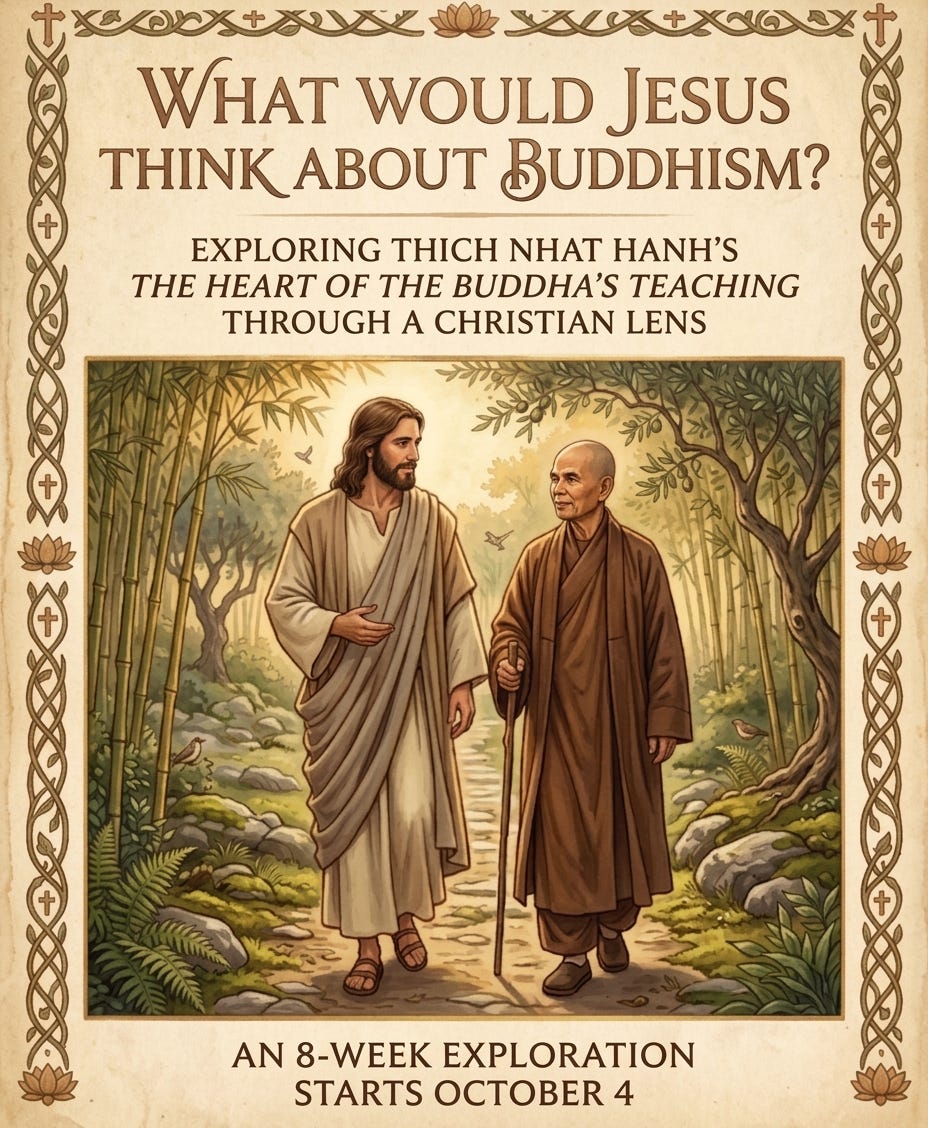
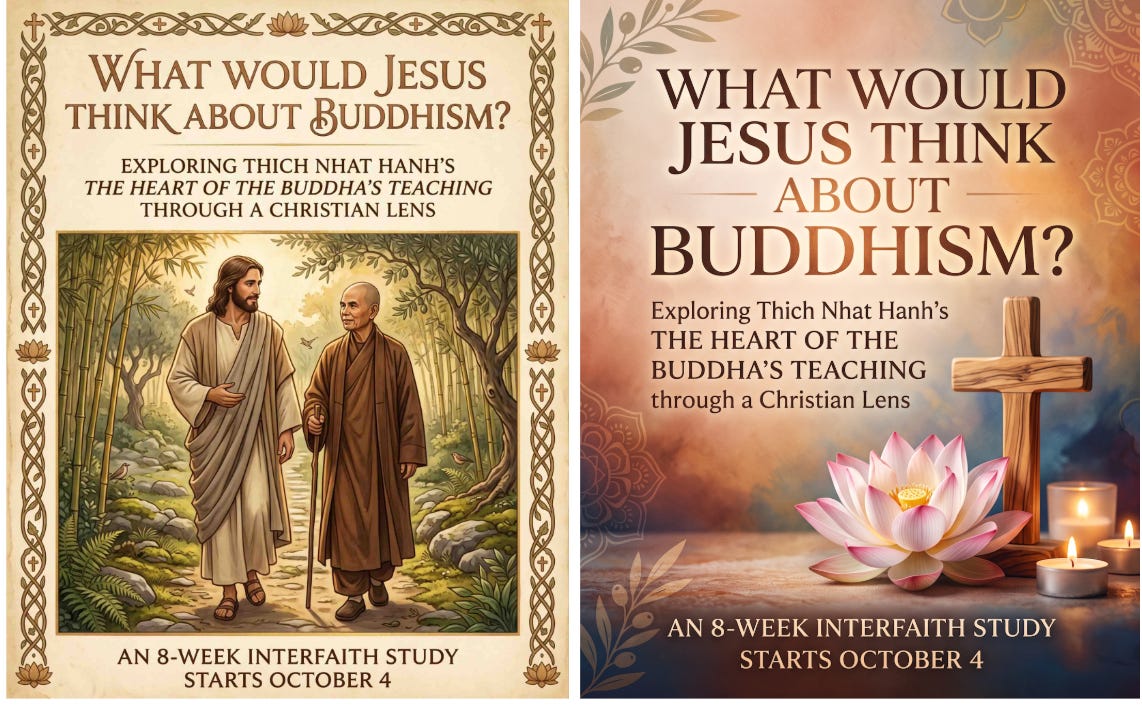
PS: Which of these social media images do you like best?

What Would Jesus Think About Buddhism? · September 24, 2026

This fall, join us for a thoughtful journey through one of Buddhism’s most treasured texts: The Heart of the Buddha’s Teaching by Thich Nhat Hanh. We’re not here to convert—we’re here to understand, to question, and to discover.

Attendance Policy

This is a no-commitment program. If you only come once, we’ll be glad you’re there. If you come again, we’ll say welcome back

The Book

In The Heart of Buddha’s Teaching, Vietnamese Buddhist monk Thich Nhat Hanh presents the core teachings of Buddhism for Western readers. The book explores the Four Noble Truth and the Noble Eightfold Path. Nhat Hanh makes these ancient teachings practical and relevant to modern life, emphasizing mindfulness, compassion, and interbeing. He draws on both traditional Buddhist wisdom and contemporary psychology, showing how these teachings transform daily living and relationships. The book has substantial overlaps with traditional Christianity and it diverges in important ways.

Guides

The Questions We’ll Ask:

  • Where do our faiths meet, and where do they diverge?

  • How do Buddhist and Christian ethics compare?

  • What can compassion teach us across traditions?

Study Details:

This study isn’t about converting traditions; it’s about deepening our faith, Christian or otherwise. We’ll examin Buddhist wisdom through Christian eyes while discovering unexpected connections. Whether you’re curious about Buddhism, exploring comparative theology, or simply seeking spiritual growth, all are welcome.

  • Begins: October 4

  • Duration: 8 weeks (ends before Thanksgiving)

  • Format: Weekly readings + discussion

  • Who: Anyone seeking deeper understanding

Some people participate in the ZOOM calls. Other simply enjoy following the weekly summary emails.

Bring your faith, your questions, and your curiosity.

ZOOM Book Club Starting This Sunday 10/4/26 · October 1, 2026

Hey, friends,

If you are seeing this, you are already a part of Christians Anonymous. Just keep your eyes open for a new post about what we’re dong on Sunday, ZOOM link, etc.

Week 1 — Foundations

October 4, 2026 · Read this week's curriculum

From the Christians Anonymous newsletter

Starting This Sunday, 10/4/2026, at 8:00 PM EST. · October 1, 2026

Friends,

I’m so excited that our book club is starting! This next round, an 8-week interfaith study of Thich Nhat Hanh’s The Heart of the Buddha’s Teaching read through a Christian lens, begins on Sunday, October 4, at 8 pm Eastern Time. We’ll meet on Zoom, every Sunday from Oct 4 through Nov 22. In the past we’ve met for one hour. The group can decide if we want to go longer.

Join Here

(Meeting ID: 846 5690 7695, Passcode: Jesus)

No reading is required for this first week. Our opening night is for getting to know one another: introductions, our goals for the club, and what each of you hopes to get out of our time together.

You can get the book in print, on Kindle, or as an audiobook on Amazon.

(No, I don’t get kickbacks from Amazon.)

I haven’t yet figured out what we’ll read for Week Two. I’ll know by Sunday. If you’re eager to get going, just start at page one and go.

A Buddha and a Christ on the same altar

Thich Nhat Hanh honored both the Buddha and Jesus as his spiritual ancestors. He kept a statue of each of them, side by side, on his personal altar.

He also taught that we shouldn’t abandon the spiritual tradition we grew up in. He wrote:

“If you enjoy sitting meditation, practice sitting meditation. But preserve your Jewish, Christian, or Muslim roots. That is the best way to realize the Buddha’s spirit. If you are cut off from your roots, you cannot be happy.”

I believe there is no conflict between being a Christian and learning about Buddhism. Still, I know some of you may wonder about this, and I want us to talk about it openly. Is anyone worried that studying Buddhism might violate their Christian commitments? Bring that question with you. We will spend some time on it Sunday evening.

Laying some groundwork

On the first night I’d also like us to go over a few basic ideas we’ll need if we’re going to really talk about Buddhism and Christianity together:

  • What do we mean by “God”? The word “square” means a geometric shape with four equal sides. Regardless of which square you gesture towards, it must meet that definition. So what does the English word “God” mean? The question is not “Who is God” or “What is God like” but what does the word itself mean, regardless of the specific entity toward which the word points.

  • The Christian picture: God and creation. In the Judeo-Christian tradition, the fundamental division of the cosmos is God and creation.

  • The Buddhist picture: confusion and right understanding. The basic movement from delusion toward seeing clearly sits underneath much of Buddhist practice.

These two frameworks shape nearly everything in the book, and once we have them in view the conversation gets a lot richer. No preparation needed, just come as you are.

Join us

Sundays, 8 pm Eastern, October 4 through November 22

Zoom link: https://us06web.zoom.us/j/84656907695?pwd=JTKurJbCMxk6IYU4wGT207tLDqRI82.1
Meeting ID: 846 5690 7695
Passcode: Jesus

I can’t wait for Sunday, and I’m looking forward to seeing every one of you. If you have any questions, just reply to this email.

Peace and Love,
Ellis

PS. Feel free to invite everyone you know. And remember: if you can only make it once, we’ll be happy to see you. If you make it every time, we’ll be even happier.

Book Club Was Awesome · October 6, 2026

Friends,

Thanks for a wonderful discussion on the fundamental orientation of Buddhism and Christianity. Although their understandings of reality are completely different, their advice on the nuts and bolts of living is remarkably similar.

Edward’s Testimony

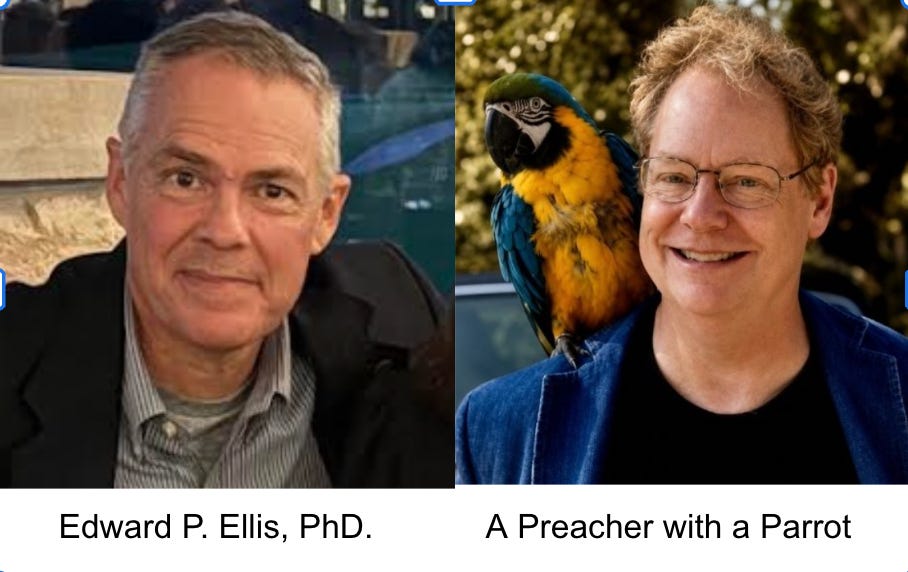
Edward is one of our guides and he has a PhD in philosophy. After college, he had become disenchanted with Christianity because of the antics of various Christians he knew. That led him to Buddhism, a tradition he rejected on various philosophical grounds that are above my paygrade. But he loved the Buddha’s focus on compassion and loving-kindness. Soon he connected the dots. Jesus also focused on compassion and love of neighbor. In that way, his study of Buddhism actually led him back into the church.

Different Problems. Different Solutions.

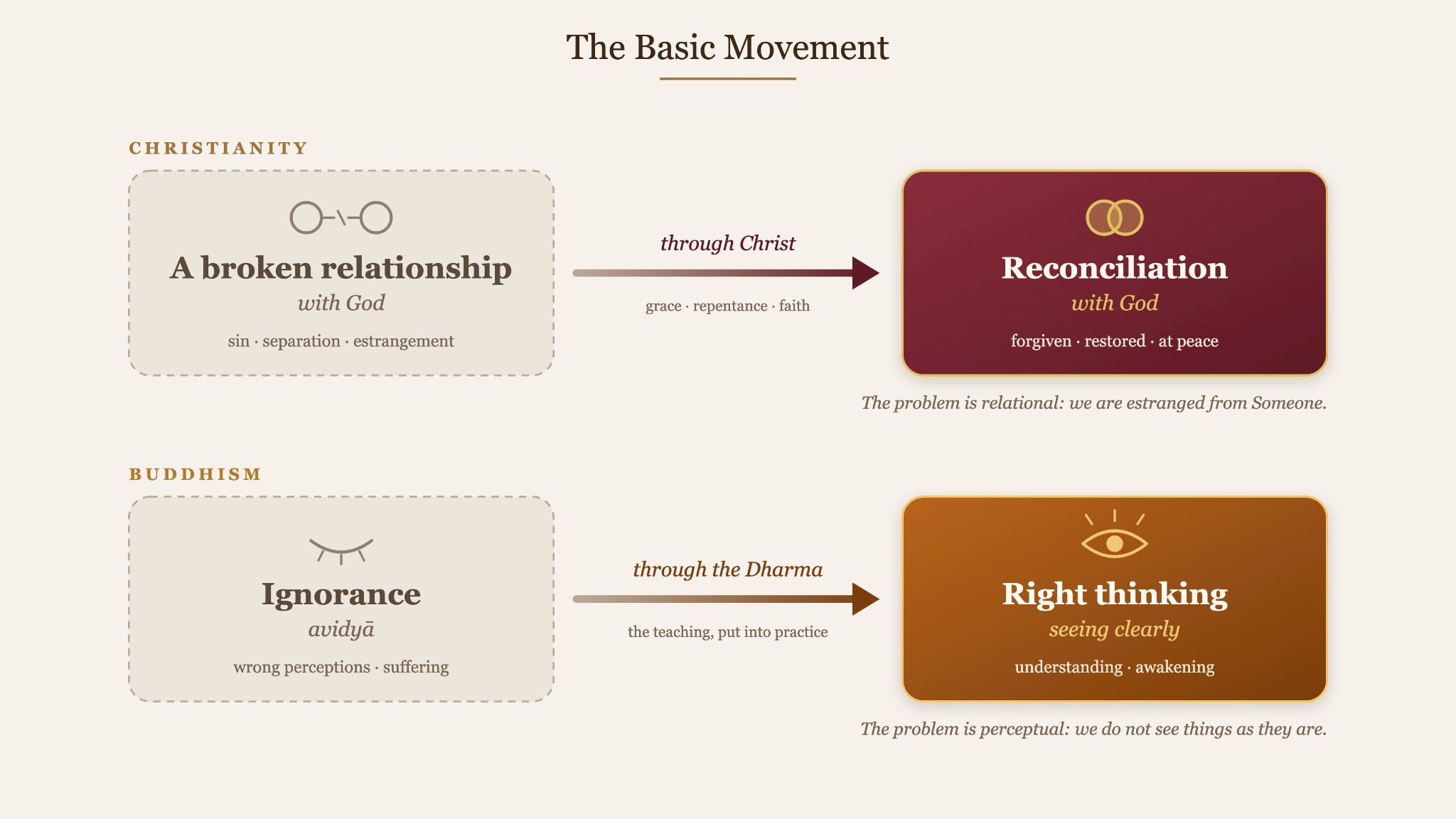
In Christianity, the fundamental problem is human separation from God because of sin. Christ is the solution because he reconciles us to God.

In Buddhism, the fundamental problem is confusion. We misunderstand reality and this causes us to suffer. This problem is solved by Dharma, the teachings and practices of the Buddha.

Both can be true. We can be separated from God by sin and confused about the nature of reality.

The Wheels of Teaching

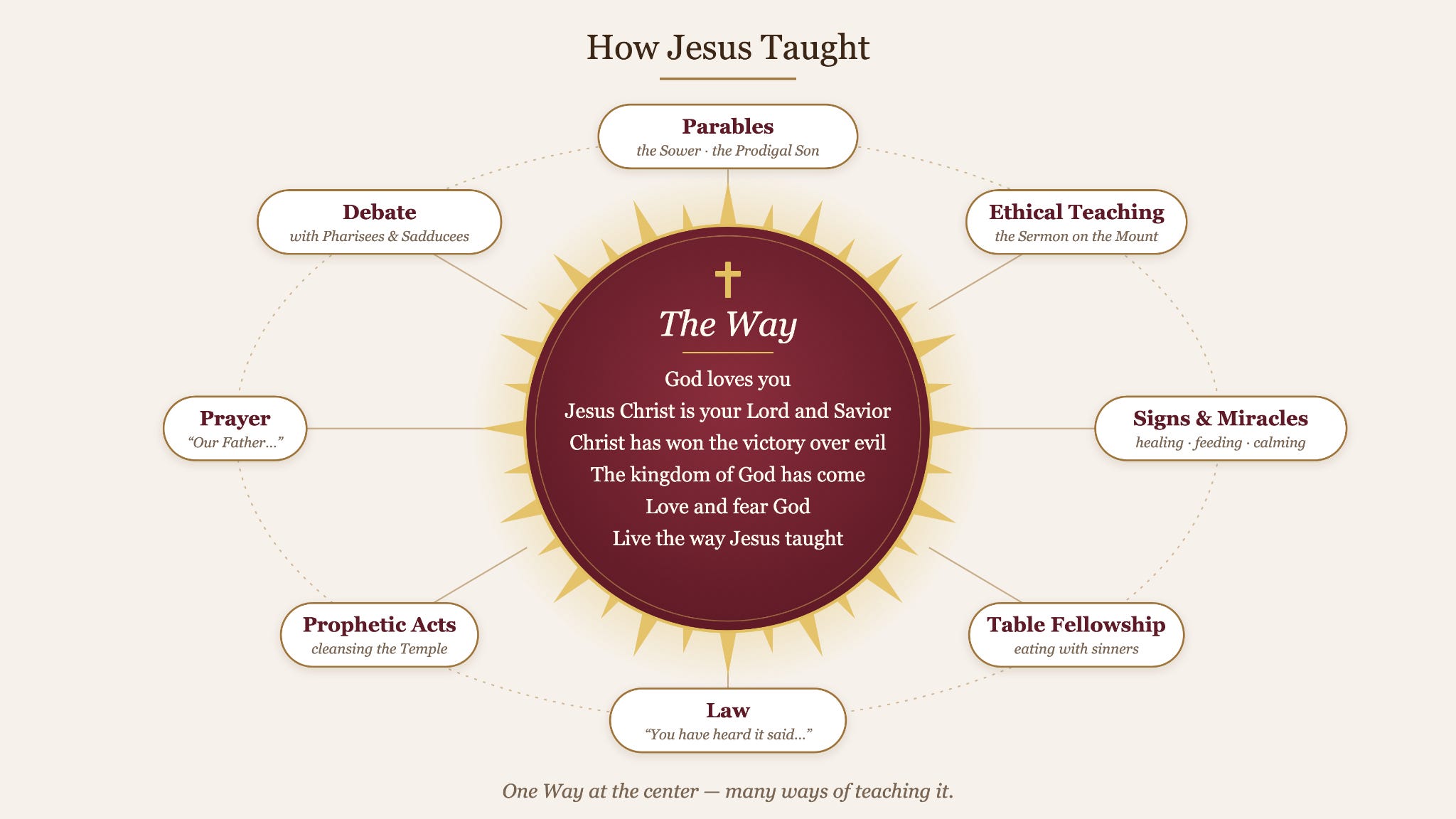
The core teaching of Christianity is The Way, or Christ’s yoke. That is a specific understanding of Torah and an expansion of who can be reconciled to God through it. Jesus uses multiple teaching methods to gesture toward it: sermons, parables, prophetic acts, etc. Some people learn by being told. “Blessed are the meek.” Others need a story like the parable of the sower. Some don’t get it until they see it in action, eating with sinners, dying on the cross. And everyone is helped by repetition.

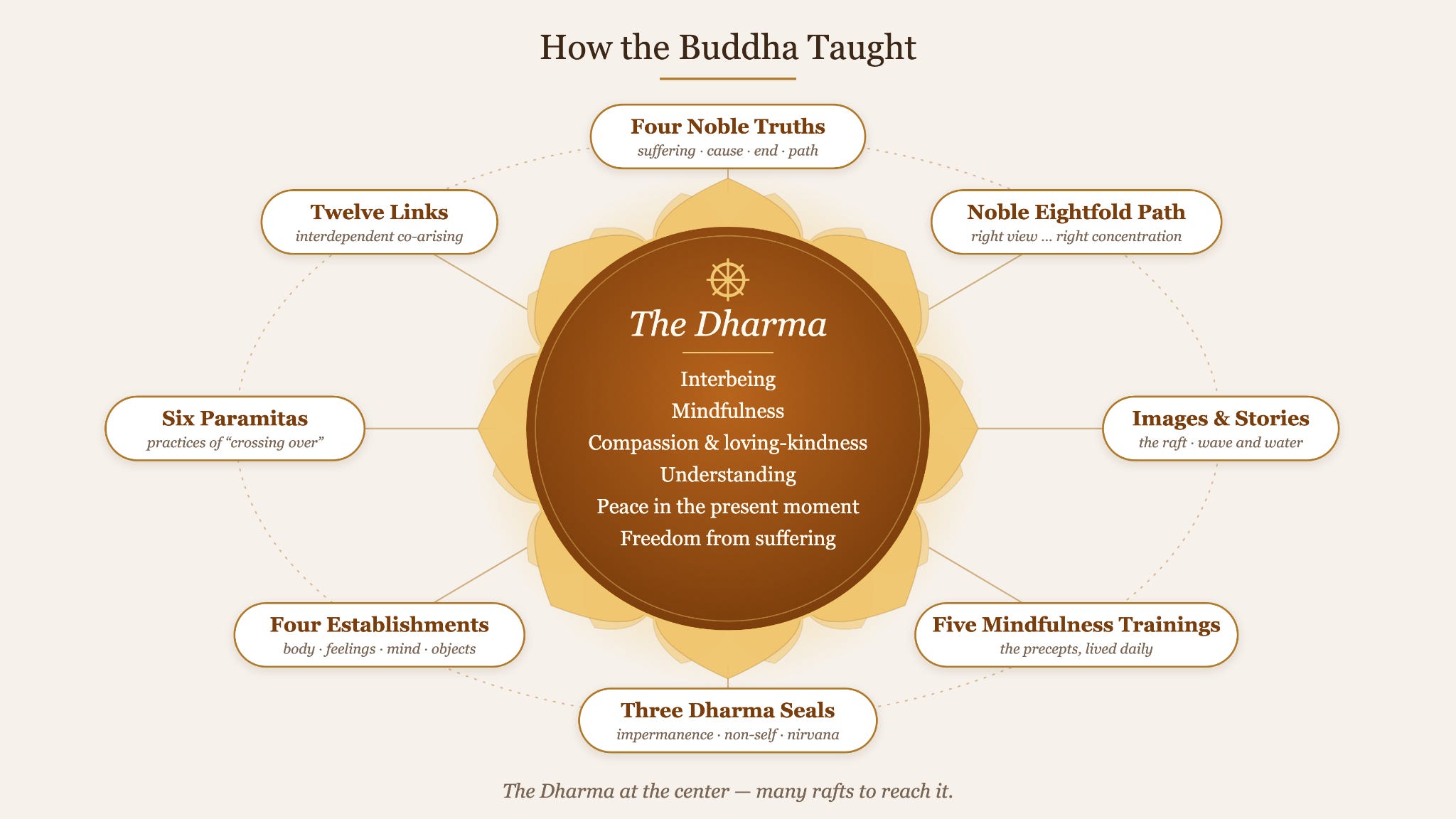
The center in Buddhism is a set of teachings and practices called Dharma. This includes the right living that Jesus taught, love of neighbor, others before self, servanthood etc. It also includes mindfulness and inter-being. Like Jesus, Buddha had several ways of teaching this core set of beliefs. Personally, it annoys me that they are all numbered: the four noble truths, the eight-fold path, the three Dharma seals. Maybe the problem is that I’m not a numbers guy.

Buddha and Jesus both have multiple doors into their treasure-chest of wisdom.

The Mind/Body Problem

There are several understandings of the relationship between our bodies and our minds (our selves, our consciousness, our agency, our souls). Christianity and Materialism are two classic perspectives. Buddhism offers a third.

  • Popular Christianity is dualistic. We are souls that get a body for some duration of time. When our bodies die, our souls remain.

  • Materialism is monistic. We are our bodies. Consciousness comes from the brain. Death is the end. We no longer are.

  • Buddhism has a concept of no-self. Yes, humans are created of matter, just like a river. And like a river, there is no set state. As Heraclitus put it, “You can’t step into the same river twice.” Consciousness arises when our senses, including the mind, meet the world, and it is shaped by memory and karma. Karma is complicated. The point here is that karma is not a part of self because there is no self of which to be a part.

The mind/body problem itself is an issue of metaphysics. Science has never answered “the hard problem of consciousness.” The Buddha is clear that we should not waste our time trying to prove what can’t be proved. He says we should spend our time learning to live rightly.

Likewise, Christ says we should strive towards righteousness.

Peace and Love,

Ellis

Week 2 — The Diagnosis

October 11, 2026 · Read this week's curriculum

Week 3 — Stopping, Healing, and Seeing Clearly

October 18, 2026 · Read this week's curriculum

From the Christians Anonymous newsletter

Christianity within Buddhism #1 · October 18, 2026

Friends,

On Friday, Colette, Bonnie, Cathy and I met for the first time face to face. It was an awesome time. Virtual spiritual community is a real thing and the Spirt can lead us to new places.

Zoom link: https://us06web.zoom.us/j/84656907695?pwd=JTKurJbCMxk6IYU4wGT207tLDqRI82.1
Meeting ID: 846 5690 7695
Passcode: Jesus

We’re supposed to read chapters 6-9 in “The Heart of the Buddha’s Teaching” for tomorrow’s 8 pm EST ZOOM meeting. Don’t worry. You’ll be fine if you haven’t caught up (or bought the book).

Instead of writing a summary, I made a video. Tell me what you think.

Peace and Love,

Ellis

Week 4 — Mind, Speech, and Action

October 25, 2026 · Read this week's curriculum

From the Christians Anonymous newsletter

Book Club Game Night Tonight 8:00 pm EST · October 25, 2026

Friends,

First, thanks and praise to Edward who led last week’s club while I was traveling. We shouldn’t be surprised that he did a great job. He is a teacher, after all. I’m just surprised that we haven’t asked him to lead more often. Make sure to give him some love.

I’ve blown off a lot of stuff this week. You probably have, too. If you need a quick refresher (i.e., you haven’t read the chapters and you’d rather not admit it), check out this summary on our site.

https://christiansanonymous.org/book-club.html#week-4

Tonight we’ll talk for a little while about Right Thinking, Mindfulness, Speech and Action. Then we’ll play a game.

It’s a simple game. We’ll look at a quote and guess whether it came from Jesus, the Buddha, Nhat Hahn, or the Apostle Paul. Hint: it will be nearly impossible to tell.

I still need to make the game so I’m keeping this one short.

Hope to see you tonight. If not, have a great week.

Here is the ZOOM meeting info:

https://us06web.zoom.us/j/84656907695?pwd=JTKurJbCMxk6IYU4wGT207tLDqRI82.1
Meeting ID: 846 5690 7695
Passcode: Jesus

Peace and Love,

Ellis

Week 5 — Finishing the Path; Two Truths and Three Seals

November 1, 2026 · Read this week's curriculum

From the Christians Anonymous newsletter

Buddhism is Making Me Lazy · November 5, 2026

Friends,

All of this “walking aimlessly” and “mindful breathing” has cut into my productivity. I have neither sent out a Christians Anonymous update or recorded A Preacher with a Parrot in a couple of weeks. Fortunately, God hasn’t yet struck me dead.

Edward did another amazing job leading out discussion. We looked at the final three steps of The Path: right diligence, right livelihood and right concentration. Then we tackled relative vs absolute truth and the three “Dharma Seals”: impermanence, nonself, and nirvana. I want to start there.

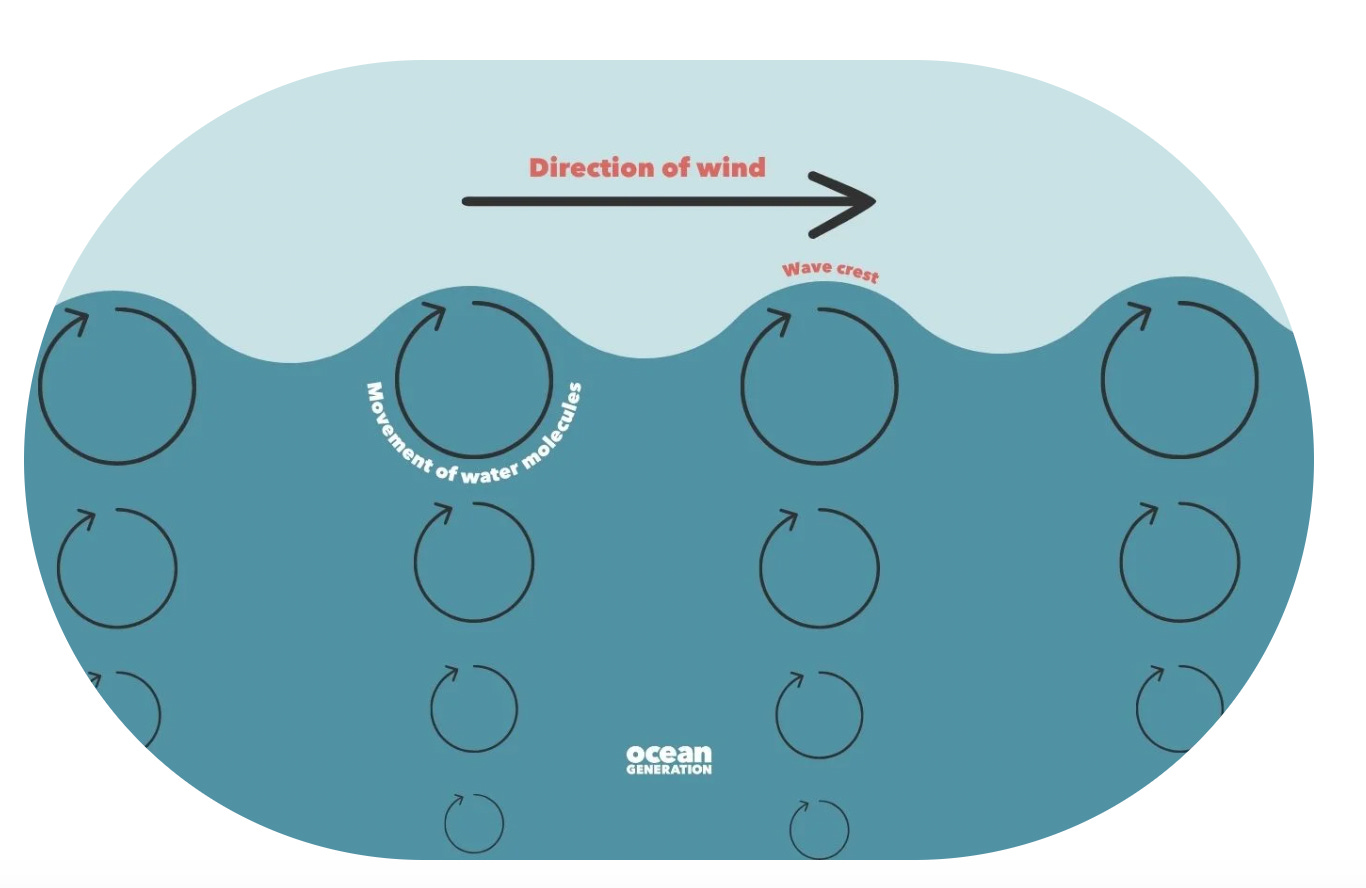
This drawing does a good job of explaining the Buddhist perspective of non-self. “We” are each a wave. A wave is real. Some waves are larger than others, for example. The wave travels over water, towards the shore and back, but the water molecules only make circles in place. The wave moves but the water doesn’t. And without the water, there can be no wave.

This is a head-scratcher. I have argued that Buddhist metaphysic is problematic. Here we see it in technicolor. If humans “aren’t” in the sense that we are just a flow of matter and energy without a stable center (a self or a soul), who is the person that is supposed to be empathetic and who are we supposed to have empathy for? Furthermore, if we “aren’t” and there are no consequences to us for terrible but enjoyable behavior (because there is no “us”) and even the sense of enjoyment is a sign (and thus untrue or at least incomplete), why should we refrain from doing “horrible” things?

I think Nhat Hanh has an answer but it’s a bit technical. It depends on the two truths: relative truth and absolute truth. He would say that empathy and responsibility matter at the relative level, i.e. our unenlightened perception of reality. Whether or not the relative level is real enough to ground ethics is where the argument lands.

I suspect the Buddha’s answer to the questions would be, “Don’t get lost in the theory. Behave like I recommend and see if it reduces suffering.” What the book offers, I think, is life hacks that prevent suffering and I think they work. The group discussed whether such hacks were present in Christianity. I said, “Not really.” Edward lifted up prayers of gratitude as an example. It appears that most of the group is not test-driving these hacks. I hope that will change.

Right diligence, livelihood and concentration are connected. Right concentration is straight out of Philippians 4:8.

“Finally, brothers and sisters, whatever is true, whatever is noble, whatever is right, whatever is pure, whatever is lovely, whatever is admirable—if anything is excellent or praiseworthy—think about such things.”

This is the one I’ve really been leaning into. It is in tension with our psychotherapeutic culture: “Tell me about your mother.” Recently, when I’ve realized I’ve been having an unpleasant thought, I try to replace it with a pleasant one. This is the “driving a good peg through a rotten one,” idea we spoke about earlier.

Right diligence (effort) and livelihood are much trickier. Lots of people work for weapons manufacturers and oil companies. Nhat Hanh would have them find new jobs. I’m not a macroeconomist, but I suspect this would cause big problems. He also says we should refrain from buying things that cause suffering. That’s pretty much everything we buy. In my head, this relates to the Christian understanding of original sin.

This week’s readings will circle around similar topics. As much as it irritates me, this is the Buddhist pedagogy. We hear the same truths in different packages. Jesus does the same thing. We encounter the same truths in moral teachings, parables, prophetic acts, debates, and miracles. We’re just so familiar with the New Testament that it doesn’t raise our hackles.

Here is the ZOOM info.

https://us06web.zoom.us/j/84656907695?pwd=JTKurJbCMxk6IYU4wGT207tLDqRI82.1
Meeting ID: 846 5690 7695
Passcode: Jesus

Have a great weekend. And wish me a happy birthday. Today I turn 28 for the 32nd time.

Peace and Love,

Ellis

Week 6 — Liberation, Refuge, Love, and What We Are Made Of

November 8, 2026 · Read this week's curriculum

From A Preacher with a Parrot

Week Six Update · November 16, 2026

Friends,

First, an AI wrote this based on our recorded meeting. Then I edited the heck out of it.

Thanks for a great discussion on Sunday. We are down to the last few weeks of Thich Nhat Hanh, and I’m surprised to be a little sad about it. Here is what we covered. As usual, we wandered, so I’ve put it in some kind of order.

Where Do We Go for Refuge?

We started with a question: where do you go when you need refuge? The answers were more honest than anything in the book. Some of us disappear into a book, any book, just to stop thinking about whatever sent us looking. Some of us used to have a basement, a stereo and a record played all the way through (until the stereo broke). Some of us find it in an empty sanctuary. For a lot of us, the answer is a person. Lucy is mine. When she’s busy and life isn’t too crazy, my hot tub makes a great little refuge.

Nhat Hanh would say we also take refuge in the Buddha, the Dharma and the Sangha. Hold onto that last one. We come back to it at the end.

Aimless Doesn’t Mean Directionless

I was taken with Nhat Hanh’s picture of walking around the forest for no reason. One objection was that the body may not be going anywhere, but the mind certainly is. That’s fair. I think he is using “aimless” differently than we do. The idea is that you are where you are and not “on your way” somewhere else. You aren’t walking to work. You aren’t walking to the grocery store. You aren’t working through your to-do list. You can even do your taxes aimlessly as long as you are actually doing your taxes and not really making you Christmas list. Is finishing the taxes still an aim? Probably. We left it there.

Equanimity Is Not Indifference

Nhat Hanh says equanimity is “an aspect of true love” and “far from indifference.” Indifference is “I don’t give a flip where I land.” Equanimity is “I love every place I could land.” We weren’t sure he nails the distinction, but we agreed there is one. Think of a good judge. She isn’t taking a side, but she cares deeply about getting it right. That’s disinterested without being indifferent.

Then I tried it on the election and discovered I have no equanimity whatsoever. Nhat Hanh would say I’ll suffer the next time we lose unless I learn to love every outcome. I’m not there yet.

This led to the usual question: how can things happen against God’s will if God is sovereign? Our best analogy was a parent who lets a child make a bad choice so the child can learn, while remaining the parent. As with all analogies, it breaks down if you push it too far. I’m highly underqualified to be God, so I’ll I won’t push it.

The Five Aggregates (Another List!)

Buddhists love a numbered list. This week it’s the five aggregates: form, sensation, perception, mental formation and consciousness. We were skeptical of any breakdown that tidy because real experience comes jumbled together. Modern psychology and neuroscience may do a better job. They say we predict the room before we walk in and then notice how it differs. That’s why I once looked 25 times for the red first aid kit that was actually black. I was bleeding.

That led to the big question: are you a body, or do you have a body? We landed in three places.

  • You are a mind and have a body (Descartes, who is more subtle than his reputation suggests: soul and body are far more intimate than a captain and a ship).
  • You are a body and the mind comes from it (the materialist).
  • You are both, like lemonade. Sugar and lemon juice make one thing, but you can separate them again. Hydrogen and oxygen make water, but it takes an external force (energy) to pull them apart.

I struggle with the idea that an unembodied “me” is really me. I have fingers and toes.

The Christian side isn’t any tidier. In Genesis, body plus the breath of God equals a living soul. By the time Persia is in charge, we are getting eternal souls. Aquinas takes Aristotle and puts a cross on him. Honestly, we don’t have a single Christian anthropology.

The Buddhist view is that no ego survives death. Nhat Hanh says the cloud never dies. It becomes the rain, then the plant, then the tea. A materialist would say something similar: you continue as particles, but not as you.

You Can’t Be a Solo Christian

This is the part I wanted to get to. Nhat Hanh gives us a trinity: Buddha, Dharma and Sangha, which is the teacher, the teaching and the community. We have our own: Christ, Scripture and the Church. Nhat Hanh says you can’t be a Buddhist without the Sangha. I’d say you can’t be a Christian without the Church. Me, my Bible and Jesus is not the Holy Trinity.

What does “by yourself” mean? Could you sit in a theology library with Augustine and Aquinas and still be in conversation with the church triumphant, the saints in heaven. But somebody had to shelve the books. Even the Desert Fathers had a community. Nobody lives in a cave alone. Humans can’t.

That raises the obvious question: does a Zoom book club count as church? We decided it does. As a minister of word and sacrament, I’d argue that what happens here is the Word. What we can’t do is share the sacraments together. That’s a real gap. (Churches also disagree about how often to celebrate communion, from twice a day to once a year, and some people treat it like a drive-through. I’ll leave that alone.)

Where This Book Is Leaving Us

Reading Nhat Hanh again has left some of us more excited about Christianity, not less. People who warn that this book will lure you out of the church are afraid. Jump in. You will discover that what you believe makes sense and can be argued for. We’ve got the message. We don’t have the hacks, and Buddhism is better at those. I say we steal shamelessly.

This Week

This week’s reading is Chapters 24 (The Five Powers) through 28 (Touching the Buddha Within). As always, this is a no-commitment club. Come whether or not you’ve read it. I’m also working on options for an Advent series and will send them soon.

The ZOOM information is the same as always. Sunday at 8:00 pm EST:

https://us06web.zoom.us/j/84656907695?pwd=JTKurJbCMxk6IYU4wGT207tLDqRI82.1

Meeting ID: 846 5690 7695

Passcode: Jesus

I look forward to seeing you there.

Peace and Love,

Ellis
Week 7 — The Perfections and Interdependent Co-Arising

November 15, 2026 · Read this week's curriculum

Coming Soon.

Week 8 — Hearing the Buddha Directly; Looking Back

November 22, 2026 · Read this week's curriculum

Coming Soon.